
Type yoga for weight loss into a search bar and the internet will promise you miracles by Friday. This article will not. What it will do is tell you, plainly, what a regular yoga practice can genuinely contribute to managing your weight — movement you will actually keep doing, strength, better sleep, calmer evenings, a steadier routine — and what it cannot do, no matter what the miracle posts say. If you are tired of being sold to, start here.
New to the studio? Our complete beginner’s guide to yoga classes in Duluth covers your first class; this article is about the longer, honest road after it.
The honest headline, first
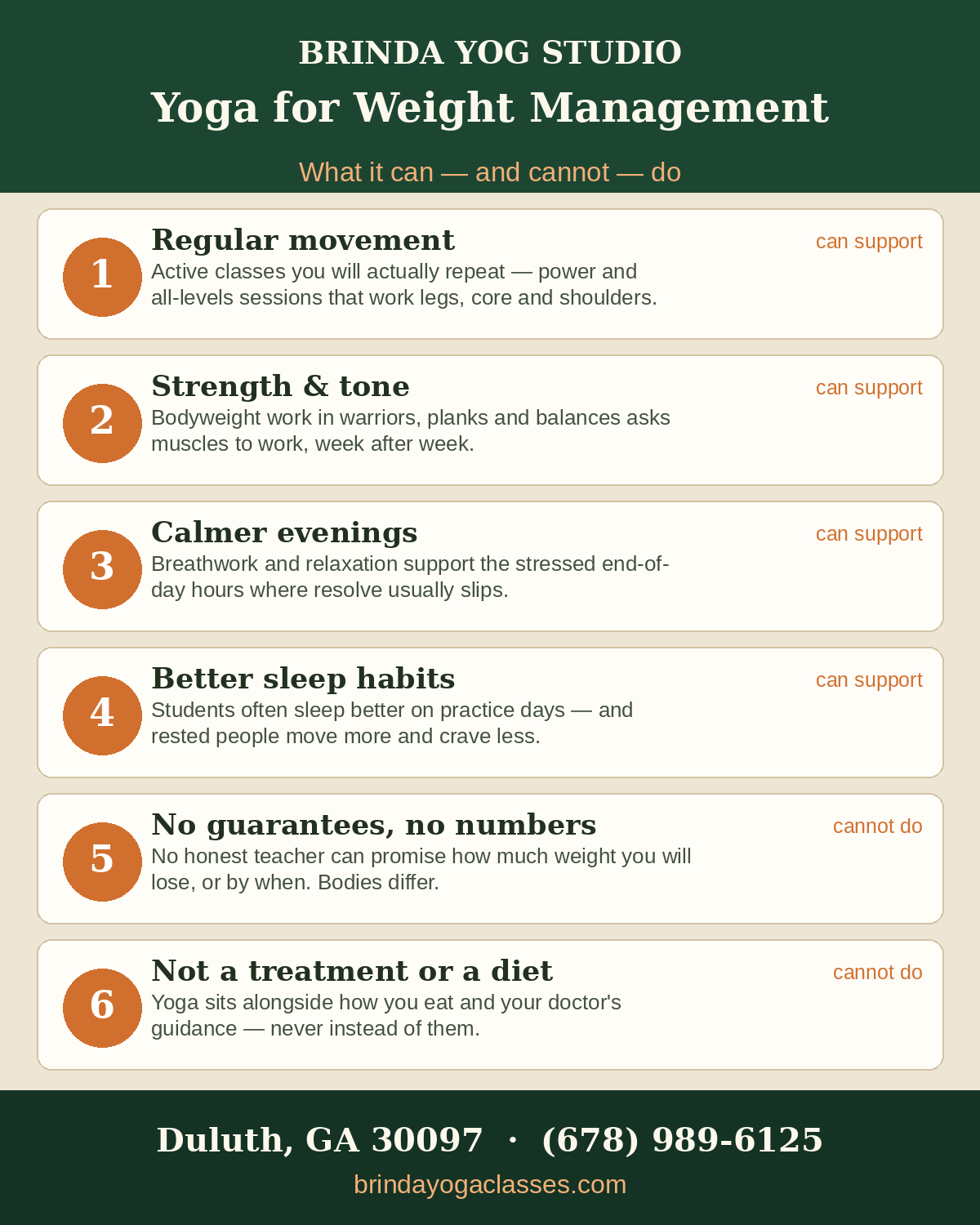
Yoga is a supportive practice for weight management. It is not a weight-loss treatment, it does not override what and how much you eat, and no teacher can honestly tell you how much weight you will lose, or by when. Bodies differ — in age, health, medication, hormones, sleep, stress and history — and any programme that quotes you a number before knowing any of that is guessing with your money.
What we can say truthfully is this: the people who manage their weight over years are rarely the people who found the most intense workout. They are the people who found movement they did not dread, and kept doing it. That is the ground where yoga genuinely competes — and often wins.
What yoga actually contributes
Movement that survives real life. An active class — flowing sequences, standing strength work, twists — is real physical work that raises your heart rate and uses the large muscles of the legs, core and shoulders. Our power yoga sessions are the studio’s most vigorous option. Just as important: a practice that includes gentle days gets repeated on tired weeks, and repeated movement is the kind that adds up.

Strength and muscle tone. Holding your own bodyweight — in planks, warriors, chair pose, balances — asks muscles to work, and muscles that work regularly are part of a healthy, active metabolism in the ordinary, unglamorous sense. We will not attach numbers to that. We will say your legs will know they attended class.
A calmer evening routine. Many of our students will tell you their hardest eating hours are not mealtimes — they are the stressed, tired, end-of-day hours. A practice that settles the nervous system — slow breathing, guided relaxation, the wind-down work in our meditation classes — supports the evenings where resolve usually goes to die. That is a supportive effect, honestly described; it is not appetite medicine.
Sleep. Poor sleep and weight management fight each other; tired people move less and crave more. Students commonly tell us they sleep better on practice days. Better rest is not a diet plan — it is one of the foundations a diet plan stands on.
Want a practice built around your body and your week — not a promise? Call (678) 989-6125 or see classes & book your spot
What yoga does not do — the list nobody puts in the ad
It does not spot-reduce. Twists do not melt one part of you, whatever the thumbnails claim. It does not cancel out eating patterns — an hour of yoga and a day of grazing are not a negotiation yoga wins. It is not the fastest calorie-burning exercise available; if burning maximum calories per hour is your only goal, high-intensity training burns more per hour, and we would rather tell you that than lose your trust. And it does not work on a deadline: a wedding, a reunion or a holiday does not change how bodies adapt, which is slowly and in their own order.
🎥 Watch: spin-twisting asanas, with Vaishali
Watch the effort honestly: these are not passive stretches. Standing and seated twists, done with control and breath, ask the core and legs to work — and it is that kind of regular, whole-body work, repeated over months, that supports an active lifestyle. One video will not change anyone’s weight. A practice you return to might change the routine the weight lives inside.
A realistic week for weight management
Two active classes. Power yoga or a strong all-levels session — the sessions that leave you warm and worked.
One gentle class. Restorative or slow flow. This is not the soft option; it is the session that protects the other two from becoming a routine you quit.

Short movement on other days. A walk, a 15-minute morning yoga routine, stairs taken on purpose. Weight management lives in the whole week, not only on the mat.
Sleep and evenings guarded. A short breathing practice before bed — the longer-exhale pattern from our breathwork teaching — instead of the phone and the kitchen at midnight.
That week contains no heroics, and that is the point. It is a week a normal person in Duluth or Johns Creek can repeat in February, which is where weight is actually managed — in the repeatable weeks.
When the conversation should be one-to-one
If pain, a health condition, medication, or a long gap since you last exercised is part of your picture, start with guidance rather than a group class. A yoga therapy conversation lets Vaishali — a certified yoga therapist — shape the practice around your body and your doctor’s guidance. And keep your doctor in the loop: significant weight change is a health topic, and yoga sits alongside your healthcare, never instead of it. Conditions our therapy pages discuss — diabetes, hypertension, hormonal balance — are supported with care, never promised cures.
What students say about regular practice at Brinda
Two students, in their own words, taken word for word from the studio’s testimonials page. These are individual experiences — not promises about what practice will do for anyone else, and neither student is quoted here as a weight-loss claim:
“Feels more active and light , and less stressed.”
— Nidhi Singh, student
“Improves my flexibility..feels energetic. Vaishali Modi as a person is very good, gr8 human being . Every morning I look forward for class with her. Doing yoga regularly has helped me a lot …it stregnthen my weak muscles. I rarely take pain killers .”
— Anjana Bajaj, student
Read more on our student testimonials page.
Frequently asked questions
It can support weight management — through regular movement, strength work, steadier evenings and better sleep — as part of an overall healthy routine that includes how you eat. It cannot guarantee weight loss, and we will not quote you an amount or a timeline. Anyone who does is not being straight with you.
Power yoga is our most vigorous class — flowing, strength-led and warm. Gentle and restorative classes play a different role: they keep the practice sustainable and support sleep and recovery. A weight-management week usually needs both kinds.
For most people, two active classes plus one gentle session a week is a realistic, sustainable pattern, with short movement on other days. More than you can repeat is less useful than this — consistency over months is what supports change.
We will not give you a date. Students often notice energy, sleep and mood shifts within the first few weeks of regular practice; visible change, when it comes, builds slowly over months and depends on far more than yoga. Beware any programme that promises otherwise.
Start with a conversation. Tell us about your health before class, keep your doctor’s guidance central, and consider beginning with a one-to-one yoga therapy session so the practice is shaped to you. Yoga is supportive care — it never replaces medical treatment.
Classes are by prior appointment only, between 9 AM and 6 PM, at our Duluth studio — minutes from Johns Creek, Suwanee and the Sugarloaf area. Call (678) 989-6125, tell us your goal honestly, and we will suggest the right first class — no promises, just a plan you can keep.
Keep the movement, drop the miracles
Weight management is not a six-week event; it is the shape of your ordinary weeks. Choose movement you respect, that respects you back — active enough to work, gentle enough to repeat, honest enough to trust. That is the practice we teach, and it is here whenever you are ready to begin.
📍 Brinda Yog Studio · Duluth, GA 30097
📞 Call (678) 989-6125 · 🗓️ See classes & book your spot · ✉️ Ask us a question
📷 Follow our daily practice on Instagram: @brindayogstudio · ▶️ Watch us on YouTube