If the word “chakra” makes you picture incense, crystals and promises nobody can keep, this guide is written for you. Chakra meditation is one of the oldest attention practices in yoga — and also one of the most oversold. So here is the version we teach at Brinda Yog Studio in Duluth: what the chakras are in the tradition they come from, what they honestly are not, and a plain ten-minute practice you can try tonight and judge entirely by how it feels. No belief required. No promises attached.
New to sitting practice altogether? Start with our beginner’s path to meditation and breathwork in Duluth — then come back to this map.
The honest version first: what chakras are, and what they are not
In classical yoga, the chakras are seven points along the spine — from the base of the spine to the crown of the head — that the tradition treats as centres of energy and attention. Each one is linked, in that traditional map, to a part of the body and a part of life: steadiness, ease, confidence, openness, expression, focus, stillness.
Now the honest part, because skeptics deserve it up front:
Chakras are a traditional map, not anatomy. You will not find one on an X-ray, and there is no scientific proof of energy centres spinning in the body. Anyone who tells you a meditation can diagnose, unblock or heal a chakra — or cure a condition through one — is promising something nobody can deliver, and we will not do that here or in our classes.
What is real is what the practice does with your attention. Moving your focus slowly from your feet to the top of your head, breathing steadily as you go, is — whatever language you wrap it in — a body scan, a breathing exercise and a concentration drill in one. Those are well within what our meditation classes teach every week, and they are the reason a self-described skeptic can sit through a chakra meditation and still come out quieter than they went in. Keep the map if it helps you remember where to place your attention. Drop the metaphysics if it gets in the way. The practice works either way, because the practice is the point.
The seven stops, in plain language
Think of the seven chakras as seven places to rest your attention, bottom to top. Here is each one translated out of the mystique — its traditional name, the plain-language version, and the simple practice we use for it in class.
1. Root — Muladhara (base of the spine)
Plainly: feet, legs, steadiness. The “am I grounded or am I rushing?” stop.
Practice: stand tall, feel both feet evenly, take five low, slow breaths. Or sit and press your feet into the floor as you breathe out.
2. Sacral — Svadhisthana (just below the navel)
Plainly: hips, ease, enjoyment. Where most of us store a day of sitting.
Practice: gentle hip circles and a flowing cat–cow, letting the movement feel easy rather than perfect.
3. Solar plexus — Manipura (upper belly)
Plainly: core, confidence, get-up-and-go.
Practice: supported core work and gentle twists, done kindly — effort without strain, breathing the whole way through.
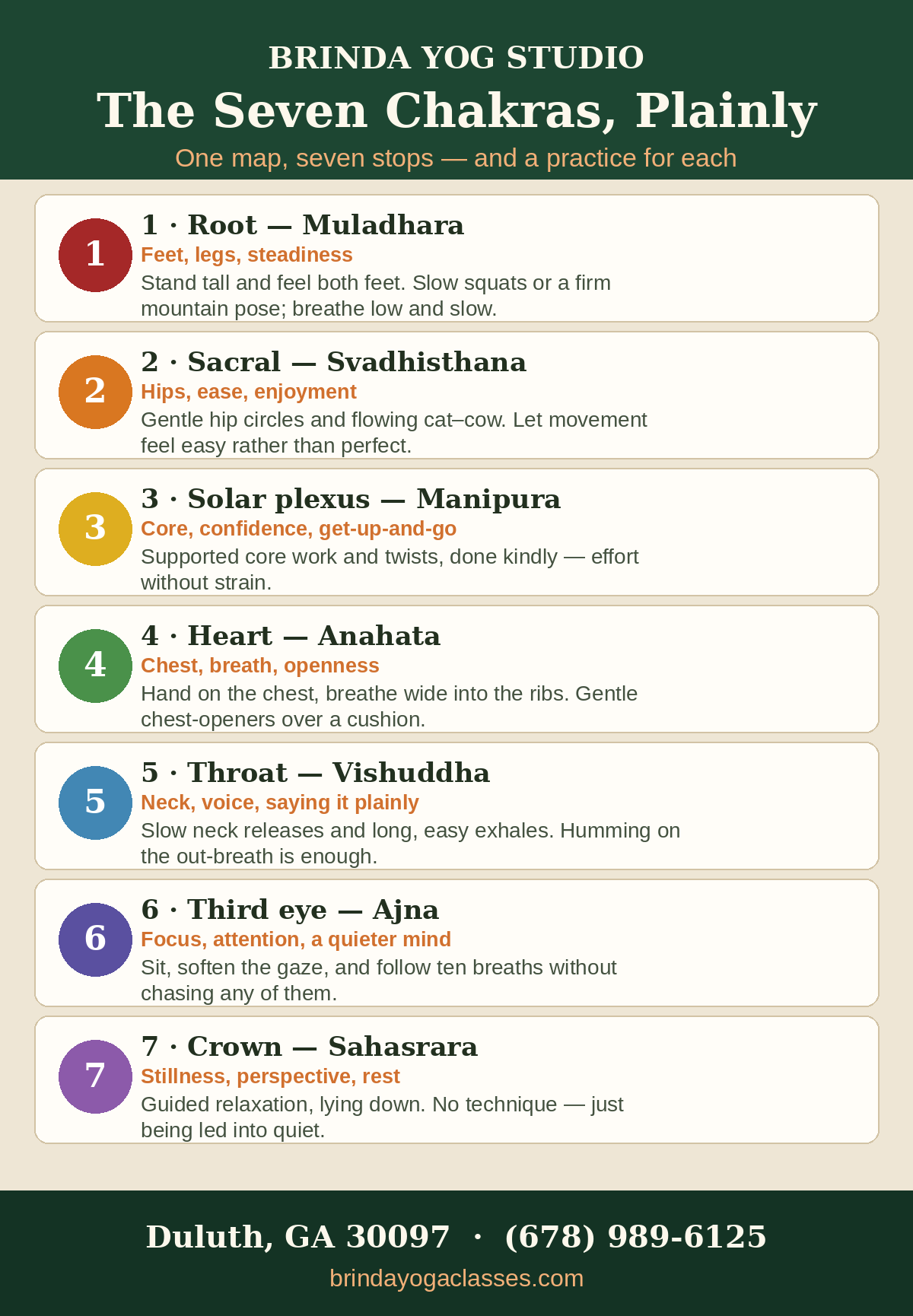
4. Heart — Anahata (centre of the chest)
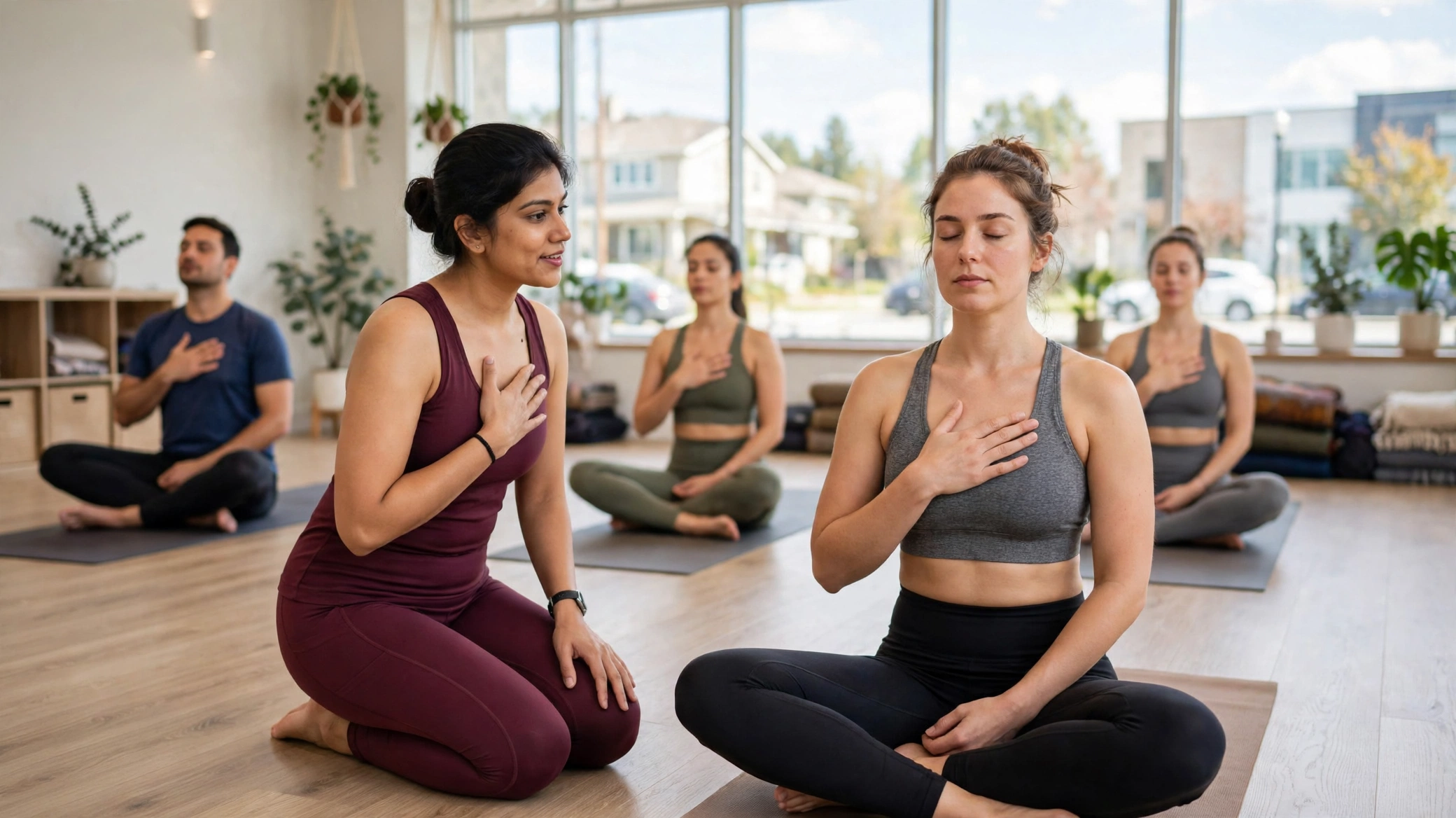
Plainly: chest, breath, openness — the stop most students say they can feel, simply because it is where the breath moves.
Practice: one hand on the chest, breathe wide into the ribs for ten breaths. Gentle chest-openers over a cushion belong here too.
Want to try this with a teacher guiding each stop? Our meditation classes are small, seated, and built for beginners and skeptics alike. Call us at (678) 989-6125 or see classes & book your spot.
5. Throat — Vishuddha (throat and neck)
Plainly: neck, voice, saying it plainly.
Practice: slow neck releases, long easy exhales — and, if you like, humming quietly on the out-breath. That vibration in the throat is the whole technique; nothing fancier is needed.
6. Third eye — Ajna (between the eyebrows)
Plainly: focus and attention — the name is grander than the practice.
Practice: sit, soften your gaze or close your eyes, rest your attention lightly between the eyebrows, and follow ten breaths without chasing any of them. When the mind wanders — it will — coming back is the exercise.
7. Crown — Sahasrara (top of the head)
Plainly: stillness, perspective, rest. In our classes this stop is not a technique at all.
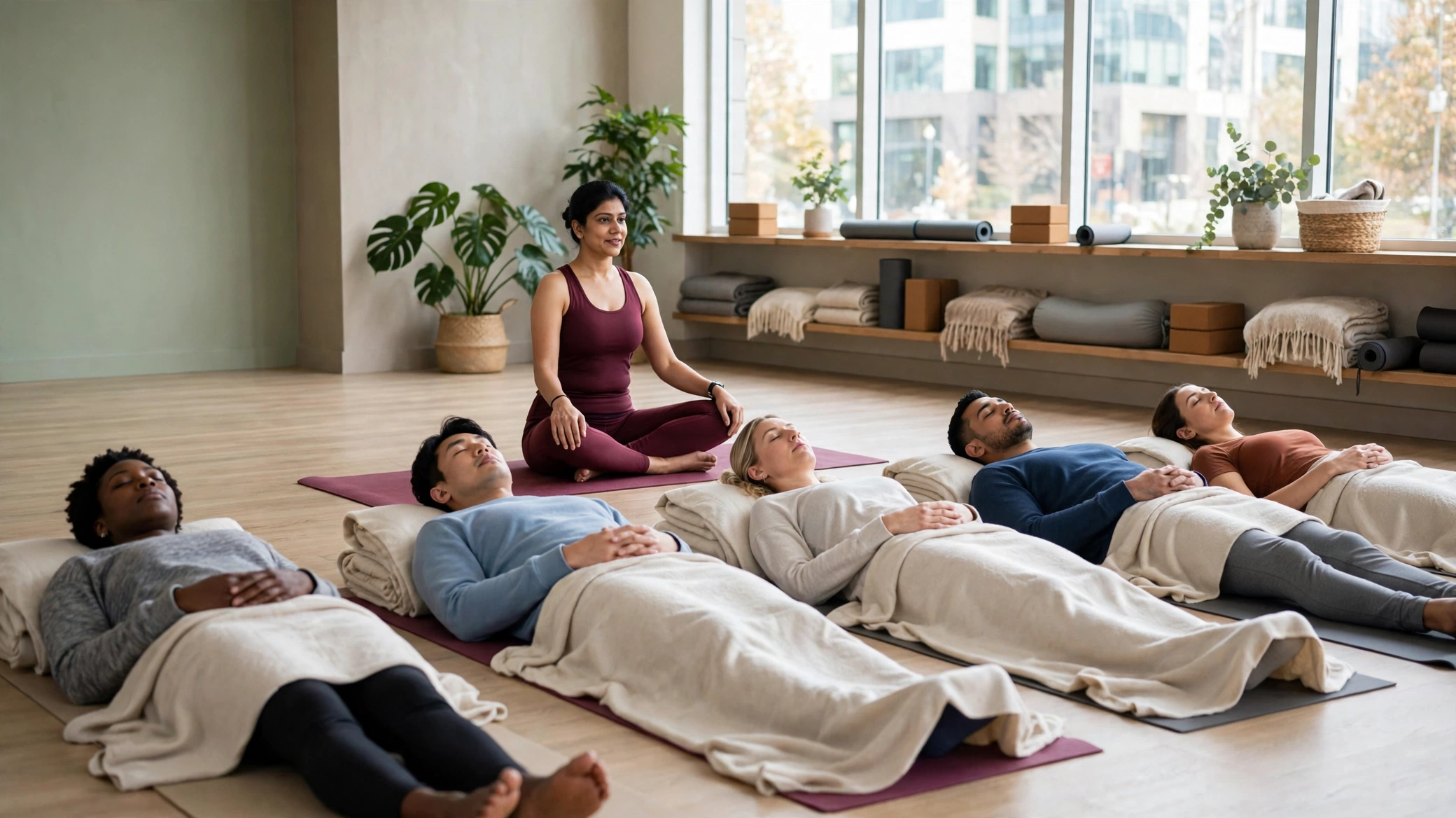
Practice: guided relaxation, lying down, being led into quiet — the part of class students consistently tell us they value most.
A 10-minute chakra meditation you can try tonight
You need a chair or a cushion, a quiet-ish room, and ten minutes. Sit tall, feet supported, hands resting wherever they are comfortable.
- Minute 1 — Arrive. Close your eyes. Take six slow breaths and let the day finish without you.
- Minutes 2–3 — Root and sacral. Rest your attention at the base of the spine, then in the low belly. Two or three breaths at each. Notice weight, warmth, contact with the chair — physical facts only.
- Minutes 4–5 — Solar plexus and heart. Move up to the upper belly, then the centre of the chest. Let the breath get slightly fuller here, the way we build it in breathwork & pranayama practice — never forced.
- Minutes 6–7 — Throat and third eye. Attention to the throat as you swallow and breathe out long and slow; then rest the attention between the eyebrows and simply count ten breaths.
- Minutes 8–10 — Crown, then whole-body quiet. Let the attention rest at the top of the head for a breath or two, then drop the map entirely. Sit in the quiet it made. When you are ready, open your eyes slowly.
That is the whole thing. If your mind wandered forty times, you did forty repetitions of the only exercise that matters in meditation — noticing, and returning. If a health condition, pain or recovery is part of your life, a guided yoga therapy conversation is the right place to adapt any seated practice to you; meditation is supportive practice alongside your own healthcare, never a replacement for it.
🎥 Watch: a gentle practice for the throat area, with Vaishali
In chakra language, the throat is the fifth stop — Vishuddha. This short practice of Vaishali’s works gently through the neck and throat region with simple asanas. One honesty note, because it matters: the video’s title uses the word “curing,” as several of the studio’s older videos do — that is the video’s name, not a promise we make. Thyroid conditions are medical conditions and belong with your doctor; a gentle practice like this is supportive movement, nothing more, and that is exactly how to use it.
What a guided class adds
The home practice above is deliberately simple. A guided class adds three things a recording cannot: a teacher who paces the stops to the room in front of her, a sequence that deepens over weeks rather than repeating the same ten minutes, and the quiet accountability of sitting with other people — the same effect our article on yoga for stress & anxiety describes. At Brinda, chakra meditation sits inside our regular meditation teaching: seated, guided step by step, and always explained in plain language first — the Sanskrit names come second, for anyone who wants them.
What students say about practice at Brinda
Two students, in their own words, taken word for word from the studio’s testimonials page. These are individual experiences — not promises about what practice will do for anyone else:
“Yoga is not something external when body meets wid soul it’s called yog.”
“Got the results perspectives of viewing life became more positive feel more energetix.”
— Keerti Sujnani, student
“Vaishaliben is a excellent teacher and a friendly person too. Ambience is also nice and I would give A+ rating to both the teacher and environment”
— Mana Raval, student
Read more on our student testimonials page.
Frequently asked questions
Do I have to believe in chakras for this to be worth doing?
No. Treat the seven chakras as a traditional map for placing your attention — feet to crown — and the practice is a body scan, a breathing exercise and a concentration drill. Belief is optional; attention is the only requirement.
Can chakra meditation cure or heal anything?
No — and be wary of anyone who says it can. Meditation is supportive practice alongside your own healthcare; it is not a treatment, it does not diagnose or fix “blocked” chakras, and it never replaces medical care. What it honestly offers is a structured way to sit, breathe and steady your attention.
Is chakra meditation religious?
It comes from the yoga tradition, and at Brinda it is taught as a practical, non-religious attention practice — no worship, no ritual, nothing to join or affirm. Students of every background, and of none, sit in our meditation classes.
My mind wanders the whole time. Am I doing it wrong?
You are doing it exactly right — noticing the wandering and returning is the exercise. A meditation where the mind never wanders would be like a gym where the weights weigh nothing. Ten honest minutes of wandering-and-returning beats an hour of performing calm.
How long and how often should I practise?
Ten minutes is a complete practice, and most days beats an occasional long one. In class, guided sessions run longer and go deeper; at home, keep the ten-minute version and let consistency do the work.
When are meditation classes at Brinda, and how do I book?
Classes are by prior appointment only, between 9 AM and 6 PM, at our Duluth studio — minutes from Johns Creek, Suwanee and the Sugarloaf area. Call (678) 989-6125 to book, and tell us you are a skeptic — Vaishali will enjoy that, and she will start you exactly where this article started: with the honest version.
Judge it the skeptic’s way: by trying it once
You do not have to buy the map to use it. Sit down tonight, walk your attention from your feet to the crown of your head for ten minutes, breathe like you mean it, and see what the quiet feels like from the inside. If you would rather be guided through it the first time — most people would — that is precisely what our classes are for.
New to yoga? Read our complete beginner’s guide to yoga classes in Duluth.
📍 Brinda Yog Studio · Duluth, GA 30097
📞 Call (678) 989-6125 · 🗓️ See classes & book your spot · ✉️ Ask us a question
📷 Follow our daily practice on Instagram: @brindayogstudio · ▶️ Watch us on YouTube